
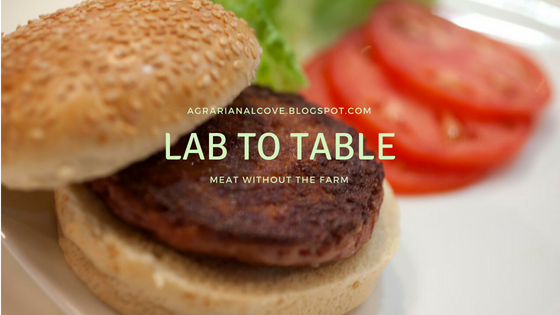
We all know PETA is against the animal agriculture industry as well as literally any other industry that has anything to do with animals. It isn’t a surprise that they offered a reward for the first person to develop lab grown (sometimes called cultured) meat and market it successfully. This is a project that has been in the making for several years. By 2012 more than 30 research teams worldwide were trying to make it happen. PETA wanted to be able to prevent animal “cruelty” by removing the animal entirely (although...this would require stem cells from animals, and lab tests so I’m not really sure what they were thinking.) Others saw test-tube meat as a means to satisfy the food source for a consistently increasing population. Still others thought that this would be a way to produce the same nutritious food at a lower cost and without burning as many resources. Animal agriculture uses water, grains for feeding animals, land, etc. It seemed like an idea that would make everyone happy. Although, I can't imagine that the people who only buy "all natural" products would try this stuff...
Stem cells of the animals are cultured in petri dishes, forming muscle segments. Small, tiny muscle segments. Most are only about 2 cm long maximum, although the first lab grown burger muscle segments only grew to .05mm. It’s also can be an off white color, which can be disconcerting. Eventually, scientists want to be able to grow larger pieces of muscle and mix it with artificial blood and fat so that it has a better texture as well as a better flavor. According to the USDA, it would be more efficient to produce this meat with a 3-D printer using bio-ink. You would be able to assemble patties and steaks because it would mimic “cell sorting and tissue fusion”. It would “ensure consistent shape” and would improve mass production.
The problem right now with lab grown meat is that it isn’t a consistent shape… It looks more like mush..but chemically it is meat. Lab grown meat, currently, would most likely only be successful if marketed as a filler such as, putting it in meatballs, or meatloaf, or meat patties. Marketing as a steak, or anything on it’s own may be hard. The consumers who don’t eat meat might try it but the majority of consumers who regularly eat meat would most likely be very skeptical of it. The consistency of the meat as well as the fat content (especially in beef, not so much in chicken) are what give meat its flavor. People who know a lot about what makes a steak good go in and look at all the flecks of fat within the meat. With lab grown meat we don’t have fat content yet. Although, producers would be able control the fat content that is in each portion of meat when they get to the point of producing large “cuts” of meat. This could be a game changer in marketing, and it may make it cheaper to purchase prime quality steaks.
It turns out that producing lab grown meat would actually be in a competitive market with actual meat, coming out at around $5000/ton. If you’ve ever purchased a quality steer or heifer you know how pricey just the animal itself can be, not to mention the feed, water, and other resources you have to pay for. The cost of the world’s first lab grown burger in 2013 was 250,000 Euros, which is more that $290,000 U.S. dollars. This is an amazingly steep price, but it included the salaries of the scientists who developed it. In 2014, scientists tried a different process to grow the cells. Transferring mature muscle cells to a bioreactor to continue growth allows the cells to produce over 56,000 lbs of meat per year. That’s from one lab. If meat was grown like this all over the world, it could significantly reduce the amount of animals needed to feed the earth. It would also allow us to reduce the production time. Most cows don’t go to slaughter until they are 3 years old. The only problem with this is that it also reduces the need for farmers. While this wouldn’t happen for many years, farmers would slowly be filtered out. Jobs would be lost at meat processing plants and ranches. David Kay, head of missions at Memphis Meats, claims that lab grown meat would mainly affect “factory farms” and not family farms. The reality is it will affect everyone in some way.
Cultured meat will make a huge impact on the world, whether its for better or for worse will depend on the jobs created and the way it’s marketed. New Harvest, a company highly invested in the first lab grown burger and research on lab grown meat, believes that milk and eggs could also be created in labs alongside meat. It could be a low cost way to feed 3rd world countries...on the other hand, most 3rd world countries depend highly on animal agriculture. So I guess it will just take time and advancement to see where this innovation takes us. Let me know in the comments below what you think lab grown meat will impact most!
https://reeis.usda.gov/web/crisprojectpages/0228895-engineered-comestible-meat.html
https://science.howstuffworks.com/innovation/edible-innovations/grow-meat-in-lab2.htm
https://science.howstuffworks.com/innovation/edible-innovations/could-you-grow-meat-from-stem-cells.htm
https://www.new-harvest.org/mark_post_cultured_beef
http://www.fao.org/docrep/004/T0279E/T0279E05.htm
https://agfundernews.com/what-do-farmers-think-about-cultured-meat.html
Do you think (pending successful mass produc./marketing) that lab grown meat would replace real meat produced by agriculture? What effects might this have on farmers??
ReplyDeleteI think that there would be a lot of push back at first from consumers, especially those who eat meat everyday and those who are concerned with chemical compounds in their food. (That's a discussion for another time.) I also think that it would take a very long time for this to completely replace meat. However, there are consumers-such as vegans and vegetarians- who might really enjoy this and purchase it as soon as it hits the shelves. I also think that there are some things that have to be perfected before it totally replaces meat. The first one being, it needs to grow more than 2cm of a muscle strand. Basically right now anything you get would have to be melded into a patty, which is why it is such a good filler meat. Thanks for commenting and stay tuned for more posts!
Delete